

Tracking gender imbalance in UK research: A nationwide snapshot
Back in November, we released the first in our series of Digital Research Reports on gender representation in research using data from Dimensions.
Today, we’re pleased to release the second report in the series which is focused on gender representation across all fields of research in UK institutions. This second report has been launched on the birthday of the Indian immunologist Indira Nath, in recognition of her award-winning research into the eradication of Leprosy in India.
Our report found that:
- There is a much more pronounced gender imbalance of researchers in science, technology, engineering and maths (STEM) research compared to Arts and Humanities research
- Contrary to popular belief, the Arts and Humanities do not have a large majority of women researchers; in fact, in the majority of fields of research, there are still fewer women researchers than men
- The proportion of researchers’ names that could not be identified by the gender guesser increased as the field of research moved from Arts and Humanities to STEM, an area which has traditionally attracted more people of Eastern ethnicity. Making gender research such as this more inclusive and truly representative calls for improvements to be made to the gender guesser program
Our research revealed that the evidence points to the answer being ‘yes’ to almost all of these questions. Our interactive tool allows researchers, departments and institutions to easily visualise the gender splits in all fields of research and across all UK research institutions. Data is represented both as a percentage of the total population, and also against population percentile to give an indication of exactly how many people this represents; for example, a field of research at an institution may have 40% women researchers, but that may relate to a small actual number of women, whereas the same field of research may have a lower percentage of women, say 30%, but the actual number of women that this relates to could be higher than the first research institution in terms of actual people, owing to their larger population.
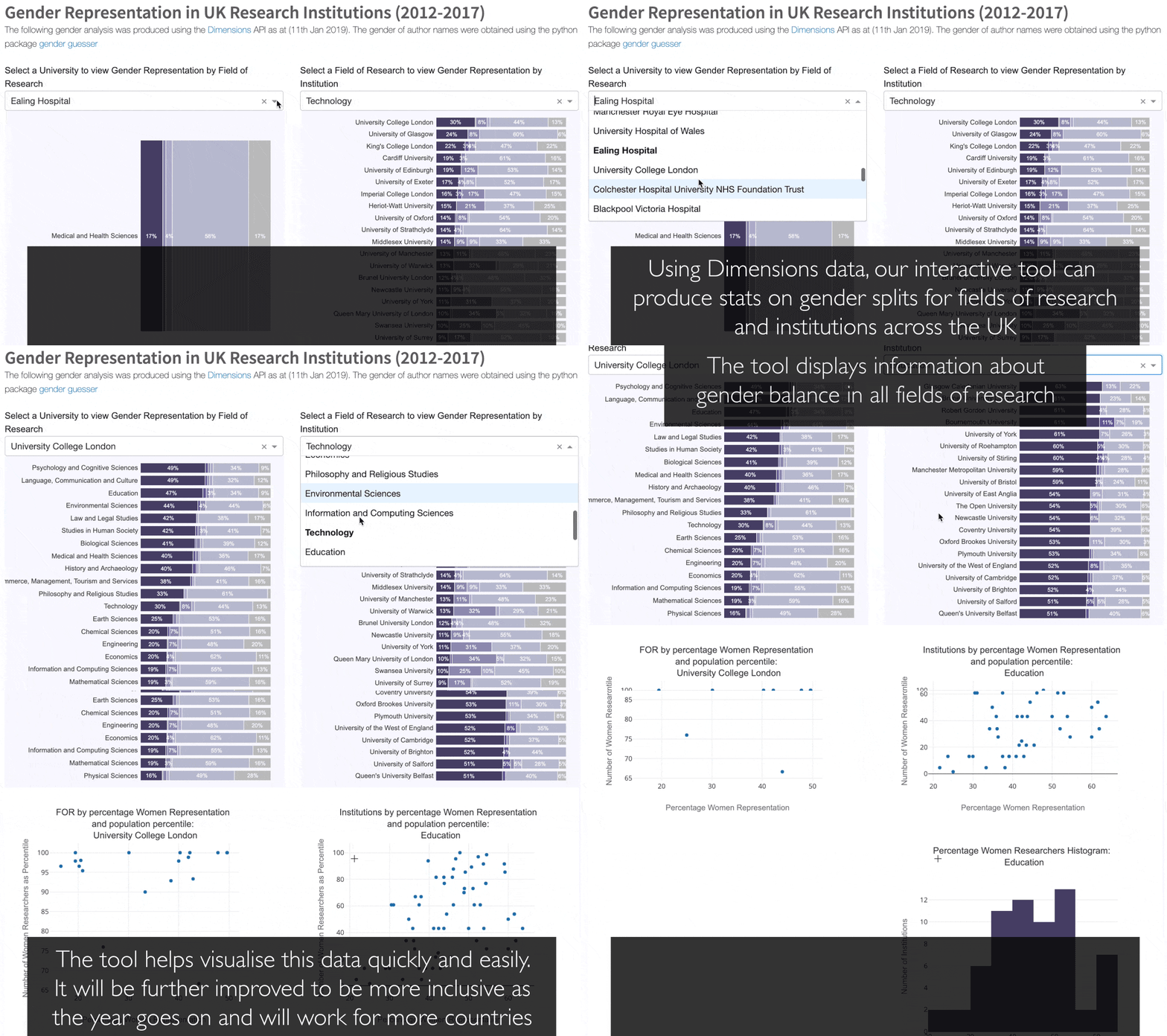
Our report uses University College London as an example of how to use the tool, but we were also able to look at data for the UK as a whole. In terms of trends, UCL was fairly representative of the research landscape of the UK as a whole. The gender splits across all fields of research confirmed that the gender balance between men and women in research is a problem for all fields of research, though STEM subjects have a much larger gender imbalance than Arts and Humanities fields of research based on this study.
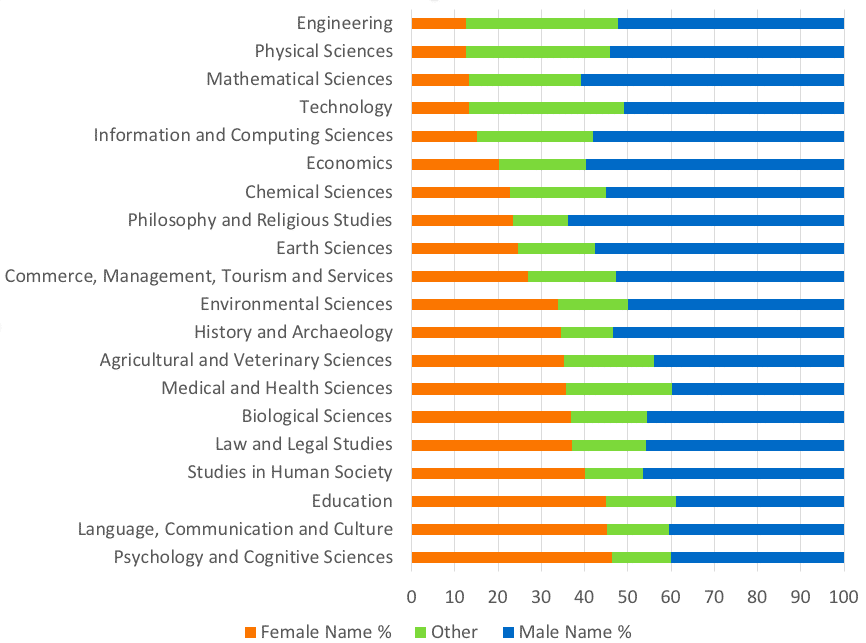
The gender guesser tool makes a range of assumptions to analyse a lot of data quickly however there may be some limitations in it. Firstly, there could be a Western bias within the program that means that some names cannot be identified easily as traditionally male or female names. Looking at the graph of gender splits by field of research above, it can also be seen that there are more names that the gender guesser could not identify in STEM fields than in Arts and Humanities fields. If there is a significant difference in the ethnic diversity of these fields, one improvement to the gender guesser that we would like to see is to make this more inclusive of all names, and therefore be able to visualise data more accurately. We will discuss this in our next instalment in this series.
Over the coming months and years we hope to update the data, firstly to expand to displaying data for a wide range of countries, and also to allow users to search for data for set time periods. We hope that this Gender Representation in Research tool will be useful to researchers in allowing them to easily monitor changes in their gender demographics over time, and identify changes made in their research culture that have led to a more inclusive and gender balanced community.
Indira Nath was born on 14th January 1938. Having initially trained as a medic in New Delhi, India, she specialised in immunology during her Nuffield Fellowship in London, UK in the early 1970s. During this time leprosy was rife in her motherland of India, and so Nath returned to India to pursue a research career in pathology and immunology. She was the founder of the All India Institute of Medical Science’s Department of Biotechnology in 1986, and retired in 1998 though continued to work as a research professor. Nath has won many awards, including the Padmashri from the Government of India in 1999 and the L’Oréal-UNESCO Award for Women in Science Asia-Pacific category in 2002.


