
Head of R&D
From concept to commercialization: Strategic imperatives for the modern R&D leader
Driving innovation requires a balance of visionary risk-taking and disciplined portfolio management.
Key strategies every R&D leader should apply to drive portfolio excellence
As an R&D leader, you stand at the intersection of scientific opportunity and organizational performance. Your responsibilities now go far beyond supervising experiments or project timelines—you are a principal architect of your organization’s future impact. To excel, you must navigate a dynamic landscape marked by information overload, evolving market demands, and relentless pressure to deliver enhanced Return on Investment (ROI).
Below, we outline seven core strategies to help you reduce risk, accelerate high-value initiatives, and ensure your R&D portfolio sustains long-term value across any sector.
1. Optimize portfolio ROI through adaptive resource allocation
Move beyond static project lists to embrace active portfolio management. Leading R&D professionals rigorously prioritize resources, ensuring that funding and talent are directed to initiatives with the highest potential for technical and commercial success. This approach demands the discipline to discontinue projects early if the data warrants it, reallocating support to initiatives with greater promise. Balancing foundational research with product-focused development helps stabilize ongoing growth while efficiently managing emerging risks.
2. Incorporate competitive intelligence in the ideation process
Innovation thrives on context. To prevent inefficiencies and redundant efforts, embed robust competitive intelligence—including patent analyses, funding trends, and marketplace dynamics—directly into your early-stage planning. Early identification of industry trends and external advancements enables your team to pursue differentiated, high-impact projects and avoid resource investment in crowded or declining areas.
3. Bridge the gap between research and application
A frequent roadblock in R&D is the disconnect between fundamental research and real-world application. Promote a culture in which insights and data flow seamlessly across teams—from initial exploration to design, engineering, and market implementation. By reducing organizational silos, you ensure critical discoveries and learning are leveraged throughout development, increasing the likelihood of successful outcomes and faster paths to commercialization or deployment.
4. Use data as a strategic asset
Treat data as a central driver of innovation, not merely a research output. Create systems that make information Findable, Accessible, Interoperable, and Reusable (FAIR). Upgrading data infrastructure enables broader adoption of advanced analytics and AI/ML techniques, supporting the rapid analysis of complex datasets. This, in turn, speeds up insight generation and shortens the pathway from prototype to practical solution.
5. Foster strategic external partnerships
Recognize the value of ideas beyond your organization. Build a culture of “Open Innovation” by establishing relationships with universities, start-ups, established industry partners, and technology specialists. Leverage global collaboration and information sources to identify rising thought leaders and innovation hubs. Well-managed partnerships enable you to access new technologies and expertise, increasing flexibility and impact without overextending resources.
6. Align innovation with organizational and market needs
Scientific achievement must deliver value—whether in market adoption, societal benefit, or operational improvement. Ensure your R&D vision is tightly integrated with broader organizational strategies and end-user requirements from the outset. Facilitate cross-functional collaboration from research teams to commercial, operations, or customer-facing groups to define target outcomes early. By aligning project goals with overarching needs, you secure smoother transitions from concept to implementation and enhance long-term success.
7. Ensure regulatory compliance from the start
Compliance is a critical, non-negotiable aspect of any R&D initiative. Build regulatory strategy into the foundation of your processes to avoid costly delays or risks down the road. Stay informed about evolving standards and requirements within your industry, and ensure your teams are trained to identify and address compliance challenges early. Proactively integrating compliance into project planning ensures your innovations meet legal, ethical, and safety standards, fostering trust and accelerating approval processes.
Driving innovation requires a balance of visionary risk-taking and disciplined portfolio management
Precise measurement is the bridge between scientific potential and commercial reality, underpinning the successful launch of products and therapeutics as key milestones of R&D achievement.
We’ve identified six key metrics that every Head of R&D should prioritize to optimize innovation
In the complex world of Research & Development, success is often defined by the long game. However, relying solely on end-of-pipeline outcomes like product or drug launches ignores the critical operational nuances that determine whether you get there efficiently. To drive true excellence, R&D leaders must track metrics that offer insights into process efficiency, strategic alignment, and the quality of decision-making.
By monitoring indicators such as pipeline velocity, data integrity, and competitive response time, you move from reactive management to proactive optimization. These metrics allow you to identify bottlenecks in the “data supply chain,” justify budget allocations for new technologies, and ensure that cross-functional teams are collaborating effectively. Below, we dive deeper into six essential metrics that define the modern, high-performing R&D organization.
1. Pipeline velocity and cycle time
Speed is a critical competitive advantage. Track the average time required to move a candidate from target identification to lead optimization, and from preclinical testing to IND/CTA submission. Monitoring cycle times at each stage allows you to pinpoint operational bottlenecks—whether they are caused by data silos, resource constraints, or decision latency. A reduction in cycle time is a primary indicator of improved R&D process efficiencies.
2. Innovation ROI and efficiency
Measure the return on your innovation investment by analyzing the cost per successful candidate versus the projected market value of the portfolio. Beyond simple financial ROI, consider “Innovation Efficiency”—how effectively capital and resources are translated into viable intellectual property. This metric helps in justifying budget approvals for high-risk, high-reward projects and demonstrates fiscal responsibility to the C-suite.
3. Intellectual property (IP) strength and quality
Don’t just count patents; measure their impact. Evaluate the strength of your IP portfolio by tracking the citation frequency of your patents by external entities, the breadth of geographic coverage, and the successful defense of claims. High-quality IP metrics indicate that your team is not just filing paperwork, but securing a robust competitive moat around your innovations.
4. Competitive intelligence response rate
In a fast-moving biotech landscape, agility is key. Measure how quickly your organization identifies and reacts to competitor moves, such as new patent filings or clinical trial results. This involves tracking the time between a major market event (e.g., a competitor launch) and the adjustment of your own strategic roadmap. High performance here ensures you avoid redundant research and pivot quickly to new market applications.
5. Data integrity and accessibility scores
Information overload and poor data organization are silent killers of productivity. Measure the “Findability” and “Reusability” of your internal data assets (adherence to FAIR principles). A tangible metric is the reduction in time spent by scientists searching for existing data or repeating experiments due to lost information. Improving this score directly correlates with faster experimental design and reduced operational waste.
6. Cross-functional collaboration impact
Innovation rarely happens in isolation. Quantify the effectiveness of collaboration between discovery, informatics, and clinical teams. This can be measured by tracking the number of shared datasets used across departments, the frequency of cross-functional project reviews, and the successful integration of clinical feedback into early-stage research. Strong collaboration metrics predict smoother transitions from prototype to launch.
Overcoming common R&D challenges in innovation
Balancing innovation, data, and cross-functional alignment
Leading a Research & Development organization means operating at the forefront of scientific and technological advancement. You must navigate a landscape defined by rapid data growth, intense competitive pressure, and the constant need to translate complex research into viable products. Addressing the core challenges of this role is essential for maintaining momentum, ensuring data integrity, and driving organizational success. By anticipating and proactively managing these obstacles, R&D leaders can strengthen their team’s ability to innovate, uphold operational excellence, and lead with confidence.
Here are some of the most common challenges faced by Heads of R&D, accompanied by practical strategies to navigate them:
1. Managing information overload and disparate data
The sheer volume of scientific literature, patent filings, and internal experimental data makes it difficult to pinpoint relevant, high-quality information. This information overload leads to redundant work and missed opportunities. Implement an integrated data platform with advanced filtering tools. This allows you to streamline literature reviews, track competitor IP, and consolidate internal knowledge, ensuring your teams can efficiently find the critical insights needed to drive projects forward.
2. Demonstrating clear return on investment (ROI)
Justifying R&D expenditures to the C-suite can be challenging, as the path from initial discovery to market launch is long and fraught with risk. Leverage portfolio management tools that link resource allocation to key performance indicators, such as pipeline velocity and IP strength. By providing clear, data-driven reports on how investments are accelerating development and de-risking the pipeline, you can effectively demonstrate the value your team delivers.
3. Bridging silos between research, development, and commercial teams
A lack of seamless collaboration between discovery scientists, development engineers, and commercial strategists can lead to misaligned priorities and products that fail to meet market needs. Establish a centralized knowledge hub that facilitates cross-functional data sharing and communication. By creating a single source of truth for project data and market intelligence, you ensure that scientific innovation is consistently aligned with strategic and commercial objectives.
4. Balancing long-term innovation with short-term execution
R&D leaders are constantly required to juggle groundbreaking, high-risk discovery projects with the more immediate demands of late-stage development and portfolio optimization. Utilize analytics to model different portfolio scenarios, balancing early-stage, high-reward projects with more predictable, late-stage assets. This data-driven approach allows you to allocate resources strategically, empowering your team to pursue innovation while ensuring operational continuity.
5. Keeping pace with a rapidly evolving competitive landscape
The speed of innovation means that competitor activities, from new patent filings to emerging technologies, can quickly render a promising project obsolete. Deploy automated competitive intelligence tracking. Setting up alerts for new publications, grants, and patents in your key areas of interest ensures you have real-time visibility into the market. This enables you to pivot strategies quickly and maintain a competitive edge.
6. Ensuring data integrity and FAIR compliance
As data becomes your most valuable asset, ensuring it is Findable, Accessible, Interoperable, and Reusable (FAIR) is a major operational hurdle that directly impacts efficiency and regulatory readiness. Adopt a robust data management framework with solutions that enforce data standards and automate data capture. This not only streamlines workflows and reduces the time scientists spend searching for information but also builds a high-quality, analysis-ready knowledge base for future projects.
Building the data supply chain for strategic R&D leadership
Fuel your strategy engine with governed, discoverable, and connected intelligence.
In the modern R&D landscape, data is not merely a byproduct of research; it is the raw material of strategy. For Heads of R&D and VPs of Innovation, the challenge is no longer just generating data, but orchestrating it into a cohesive “data supply chain” that feeds the C-suite’s strategy engine. To drive R&D efficiency and pinpoint market insights, you need an ecosystem where governance and discoverability are built-in from the ground up, not bolted on as an afterthought.
At Digital Science, we partner with R&D leaders to construct this integrated infrastructure. By connecting proprietary internal data with the world’s largest linked research information datasets, we enable you to optimize innovation, de-risk portfolios, and accelerate the transition from concept to commercial reality. Our solutions ensure that your organization’s knowledge assets are structured, compliant, and ready to power the next generation of discovery.
The components of your strategic data supply chain
We’ve outlined our core solutions that function as the critical nodes in your data ecosystem, helping you streamline workflows and maintain a competitive edge.
1. metaphactory
Semantic knowledge graphs for data interoperability
Siloed data kills innovation. metaphactory acts as the connective tissue of your data supply chain, using semantic knowledge graphs to link disparate data sources—both internal and external—into a unified, navigable view. It transforms complex, unstructured data into meaningful insights, allowing scientists and strategists to “traverse” the connections between compounds, targets, and market data. This built-in discoverability ensures that valuable insights are never lost in the noise.
2. metis
AI powered search and discovery
metis adds a layer of AI-driven modeling, search, and discovery on top of the knowledge graph created by metaphactory. While metaphactory provides the unified data landscape, metis allows you to build and deploy intelligent agents that navigate this landscape to find information faster and more intuitively. It enhances your ability to query complex relationships within the data, automating the discovery of connections that might otherwise be missed. This allows users to ask more sophisticated questions and receive precise, context-aware answers, accelerating the path from data to decision.
3. Dimensions DaaS (Data as a Service)
The foundation of global market intelligence
Dimensions DaaS serves as the bedrock of your competitive intelligence strategy. It provides direct, programmable access to the world’s largest linked research database, covering publications, grants, clinical trials, patents, and policy documents. By integrating this vast external dataset directly into your internal systems, you can train AI models, spot emerging trends before they hit the mainstream, and validate investment decisions with global evidence. It allows your data scientists to query the entire research landscape without leaving your secure environment.
4. Altmetric API
Real-time impact & engagement monitoring
Understanding the broader conversation around your research is vital for strategic positioning. The Altmetric API provides programmatic access to real-time attention data, allowing you to integrate mentions from news outlets, social media, and policy documents directly into your own analytics platforms. For R&D leaders, this provides early signals of market reception and scientific influence, helping you measure the “share of voice” your innovations command and pivot communication strategies based on sentiment analysis.
5. IFI CLAIMS DaaS (Data as a Service)
Precision intellectual property intelligence
Innovation requires freedom to operate. IFI CLAIMS DaaS delivers the trusted global patent data that fuels robust IP strategy directly into your data ecosystem. By providing standardized and corrected patent data via API, IFI allows your data teams to build custom analytics and alerts. This allows R&D leaders to map competitive landscapes with precision, identify white space opportunities, and track the IP velocity of competitors, ensuring your portfolio is both protected and differentiated.
6. ReadCube
Streamlined literature management & discovery
Your team spends hours searching for and managing scientific literature. ReadCube optimizes this essential workflow by providing a centralized, compliant platform for accessing, organizing, and sharing literature. It ensures that your scientists have immediate access to the full text of critical papers while automating the management of copyright compliance and subscription costs. This efficiency gain translates directly into more time at the bench and faster experimental design.
Get whitepaper
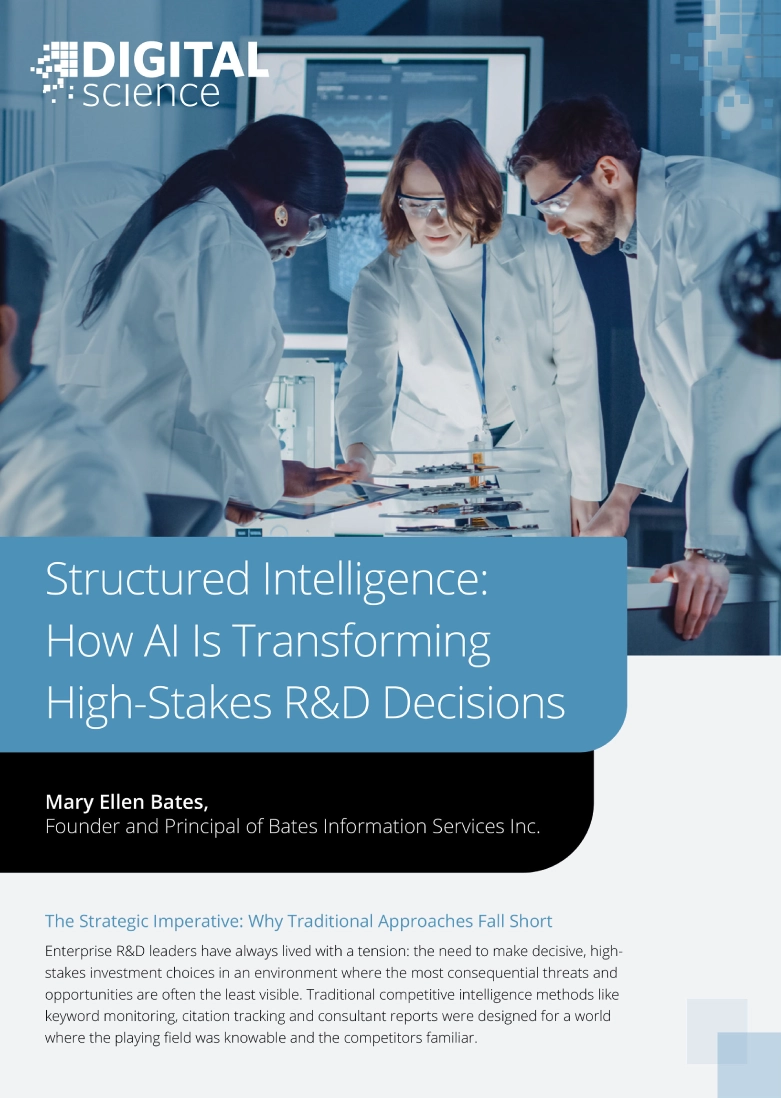
Structured intelligence: How AI is transforming high-stakes R&D decisions
Learn more
Access our on-demand webinar now to hear how R&D leaders across pharmaceutical, chemical and technology enterprises are rethinking the role of AI in strategic decision-making.