
Reimagining peer review: how the Physiome Journal is setting a new standard for reproducible science
Presented during Peer Review Week in September 2019, this 12-slide deck from Simon Porter of Digital Science and Jared Watts and David Nickerson of the University of Auckland’s Physiome Modelling Institute showcases a bold reimagining of how peer review can work in computational science. The Physiome Journal is positioned as an exciting proving ground for Digital Science’s tools and infrastructure, offering a unique opportunity to explore how reproducibility can be embedded directly into the publishing workflow — not bolted on as an afterthought.
At the heart of the project is a powerful insight: peer review in this context is really curation. Reviewers don’t just assess writing — they verify that metadata is correct, that models execute, that results can be replicated within tolerance, and that annotations are accurate. To make this rigorous process scalable and trustworthy, the team adopted an “identifier-first” approach, linking every submission to persistent identifiers for papers (via Dimensions), funding (Dimensions), authors (ORCID), and institutional affiliations (ROR). This rich, structured data layer transforms peer review from a subjective process into a verifiable, auditable one.
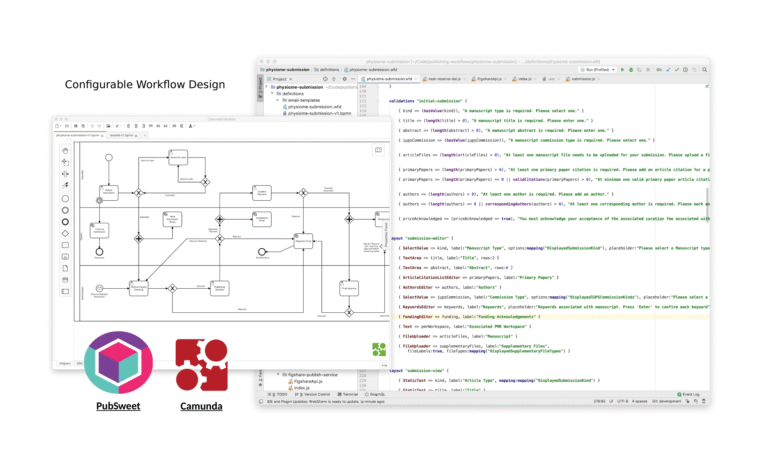
Under the hood, the solution is built on a modern, configurable technology stack combining PubSweet for the user interface and forms, a flexible data model, and Camunda as the workflow engine — all bundled into a deployment package using a domain-specific language (DSL) for workflow description. Once an article clears peer review, it is published directly to Figshare via API, complete with a Crossref DOI, with revisions handled through the same seamless pipeline. With a planned go-live date of January 2020, the project represents a compelling blueprint for how open research infrastructure can power the next generation of scientific publishing.