Why you should be getting all of your information in one place
If you’re responsible for research decisions, you’re carrying more risk than ever.
You’re being asked to approve collaborations you didn’t initiate and don’t understand the full picture of. You’re reviewing candidates you don’t have time to fully assess. And you’re signing off decisions that may be questioned months or years down the line.
And the information you need to do that properly is rarely in one place. In fact, it’s usually scattered across a range of outdated, unintuitive systems.
Dimensions brings that context together, so you can stop piecing things together manually and start working with a clear, defensible view of the full picture.
It means fewer unknowns, less back and forth, and decisions you can stand behind when they’re challenged.
How Queen Mary University of London made due diligence faster and more defensible
At Queen Mary University of London, due diligence checks used to rely on manual searches across multiple sources.
That meant:
- Hours spent verifying affiliations and collaborations
- Inconsistent results depending on who carried out the check
- Growing pressure to evidence decisions for funders and audits
Now, their team can review a researcher, their network and their funding context in one place.
They can spot and act on potential risks quickly, understand where those risks come from, and keep a clear record of how decisions were made.

I can see any potential risks at a glance and then drill down into the specifics.”
How the University of Jyväskylä built a fairer, more consistent hiring process
At the University of Jyväskylä, hiring panels were facing a different challenge.
Shortlists were long and publication histories were increasingly complex. There was a clear need to move away from judging candidates based on journal names alone.
So they built an automated workflow using Dimensions to:
- Pull together a complete, accurate publication record
- Surface a representative set of research outputs
- Highlight impact using citation context and policy mentions
- Map collaboration networks across institutions and countries
The result is a consistent, bias-aware starting point for every candidate.
This is where the Dimensions API really shines.”
Here’s what you’ll learn:
- What faster, more reliable research security checks actually look like in practice
- How to reduce manual effort while improving consistency and auditability
- How to approach academic hiring in a way that aligns with DORA and CoARA
- How to build a clearer, evidence-based view of research activity across your institution
Get case study
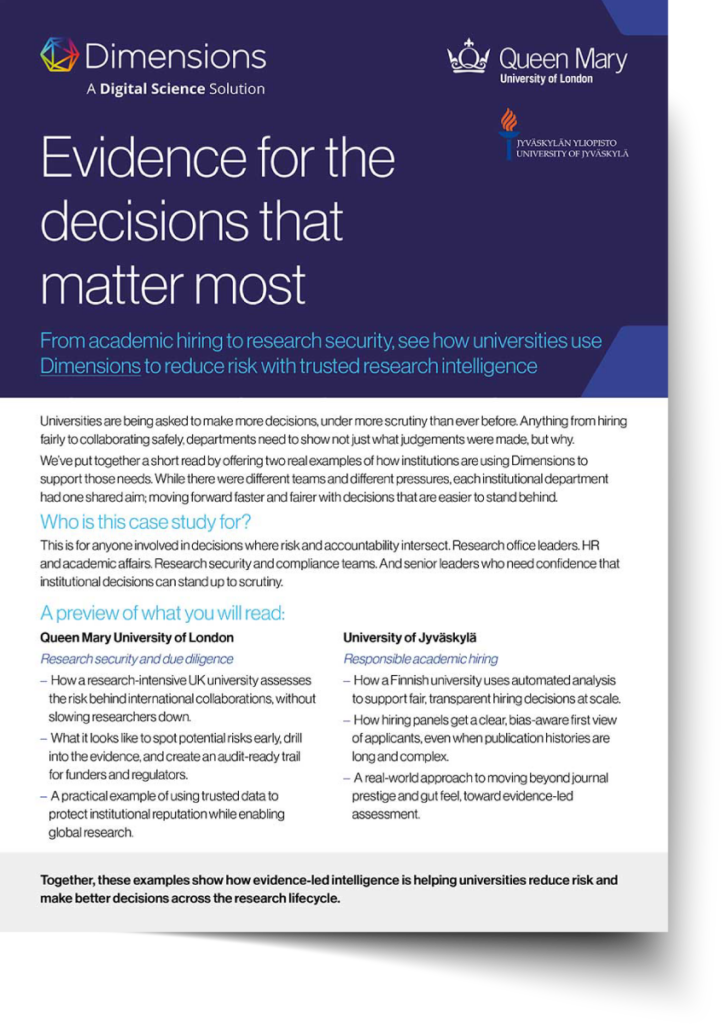
Evidence for the decisions that matter most